| Inst. f. Technische Mathematik, Geometrie und Bauinformatik, |
| Dept. of Sport Science, University of Innsbruck, Austria, |
| Dept. of Mathematics, University of Tampere, Finland |
The pressure distribution on the running surface of a ski is an important factor in ski design. However, it is a difficult task to measure the pressure distribution or to determine it computationally. There are several factors with significant influence. Among these we mention the contact area between ski and snow, the penetration depth into the snow surface as well as stiffness properties of the ski and the hardness of the snow.
Due to the side cut of the ski, the edged ski touches a rigid and plane surface on two points near its tip and its tail. After loading the ski is bent until the whole edge has contact with the surface. The line of contact is a circle with radius
On a non-rigid surface the ski compacts the snow and the edge penetrates into the snow. In the area of contact the snow reaction forces act on the ski. We assume that these forces are proportional to the penetration depth and act normal to the running surface. Thus, the pressure distribution under the ski can be computed, if the penetration of the ski into the snow and its deformation is known.
Obviously, the pressure distribution depends on several parameters: 1) On the hardness of the snow which is described by the constitutive equation. 2) On the loading of the ski which is characterized by the normal force and the torques and with respect to the longitudinal and transversal axis. 3) On geometric properties of the ski like length, width, camber height, side cut and thickness as well as on mechanical properties like flexural and bending stiffness. These factors can be used by the ski design to build an optimal ski.
A modern ski is built up in a complicated way. We model the ski as an elastic beam consisting of several layers of different materials. For the physical dimensions we use data of real skis. Additionally, one needs the mass density , the Young module and the Poisson number for each material. First, the total mass, the center of gravity, and the inertia tensor are computed. Then, the position of the neutral line is calculated. Finally, the flexural stiffness is obtained by averaging over all materials. For the torsional stiffness one has to compute the torsion function, which is a solution of the Poisson equation. Since the series expansion converges rapidly, we use the first terms, only.
In our model we assume compacted, homogeneous snow. The pressure on a small flat plate penetrating a distance into the snow is given by
The pressure distribution follows from the deflection and torsion of the ski. To obtain these quantities, one has to solve the differential equations for the elastic beam deflection and for the torsion angle. The line load and the torque are computed from the loading of the ski and the pressure distribution under the ski belonging to a certain deflection and torsion. In formulas, one has to integrate the following nonlinear boundary value problem numerically:
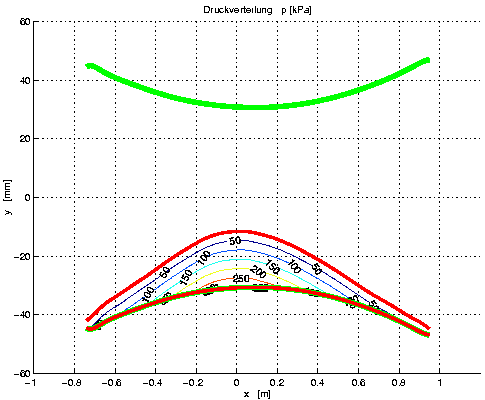
In Fig. 1 the pressure distribution on the running surface of an edged ski is shown. The situation refers to hard snow conditions. The loading kN, Nm, and Nm leads to an edging angle of 58 degrees.
The x-y plane describes the running surface of the ski. The x- and y-coordinate give the position on the curved longitudinal and transversal ski axis, respectively. Note, that the two axes are scaled differently. The edges of the ski are denoted by the two thick lines in the top and bottom of the figure. The thin lines give levels of constant pressure. In the region without snow contact there is no pressure. In the investigated case, only a small portion of the ski has contact with the snow. The pressure is largest along the inner edge and reaches a peak value of 250 kPa.
If the curve that represents the edge of the ski is projected orthogonally to the snow surface, one obtains a curve which is nearly part of a circle. The radius of this circle represents the radius of a purely carved turn. This radius might be considerably smaller than the radius predicted by the formula in the introduction.
[1] P. Kaps, M. Mössner, W. Nachbauer: Kurvenradius bei geschnittenen Schwüngen. Institut f. Technische Mathematik, Geometrie und Bauinformatik, Universität Innsbruck, 1999.